Homeowners' pick for appliance repair across the Ohio Valley
Ice Maker Stopped Making Ice
If the freezer is still cold but the bin is empty, the trouble is almost always water getting in, not the sealed cooling system. You reach in and come up with a handful of nothing, or a few hollow cubes stuck together, while the food sits there frozen solid. That's usually the cheaper end of the problem. Call us and we'll walk through it with you.
Call (800) 967-1507- You reach a person, not a menu
- Open every day
- The quote comes first, in writing
Taking calls until 5:00 PM ET
By our service team · vetted by the techs who do this daily
What "no ice" actually tells us
An ice maker needs cold air, water, and a signal to dump the cubes. If your ice cream is still hard, cold air is fine. That leaves water and the harvest cycle, and we start at the water side because it's cheap and it's where most Ohio Valley failures live. Our limestone water leaves scale on everything it touches. Small, hollow, or cloudy cubes mean water is arriving, just slowly. Zero cubes with a bin full of frost means water arrived once and froze somewhere it shouldn't. Different symptoms, different repairs. Tell us which one you're seeing when you call.
Cause family one: the water isn't getting there
Cheapest first. The shutoff valve behind or under the fridge gets bumped when someone cleans or moves it. A saddle valve on old copper pipe clogs with mineral crumbs, and the plastic supply line kinks when the fridge slides back against the wall. In older shotgun houses that line often runs a long way from the sink cabinet, and every foot is a chance to pinch it. A clogged water filter counts here too. If the dispenser also runs weak or dry, the problem is upstream of the ice maker, not in it.
Cause family two: ice is blocking its own path
The fill tube that squirts water into the mold can freeze into a solid plug, and then no water gets in and no ice comes out. Sometimes you'll find one giant lump in the mold instead of cubes. A worn door gasket lets humid river-valley air in, and that air turns to frost on everything it reaches. The chute to the door dispenser ices over the same way, so the machine makes ice but can't hand it to you. Check that first. If the bin is full but the door gives you nothing, it's a chute problem, not a maker problem.
Cause family three: parts that quit
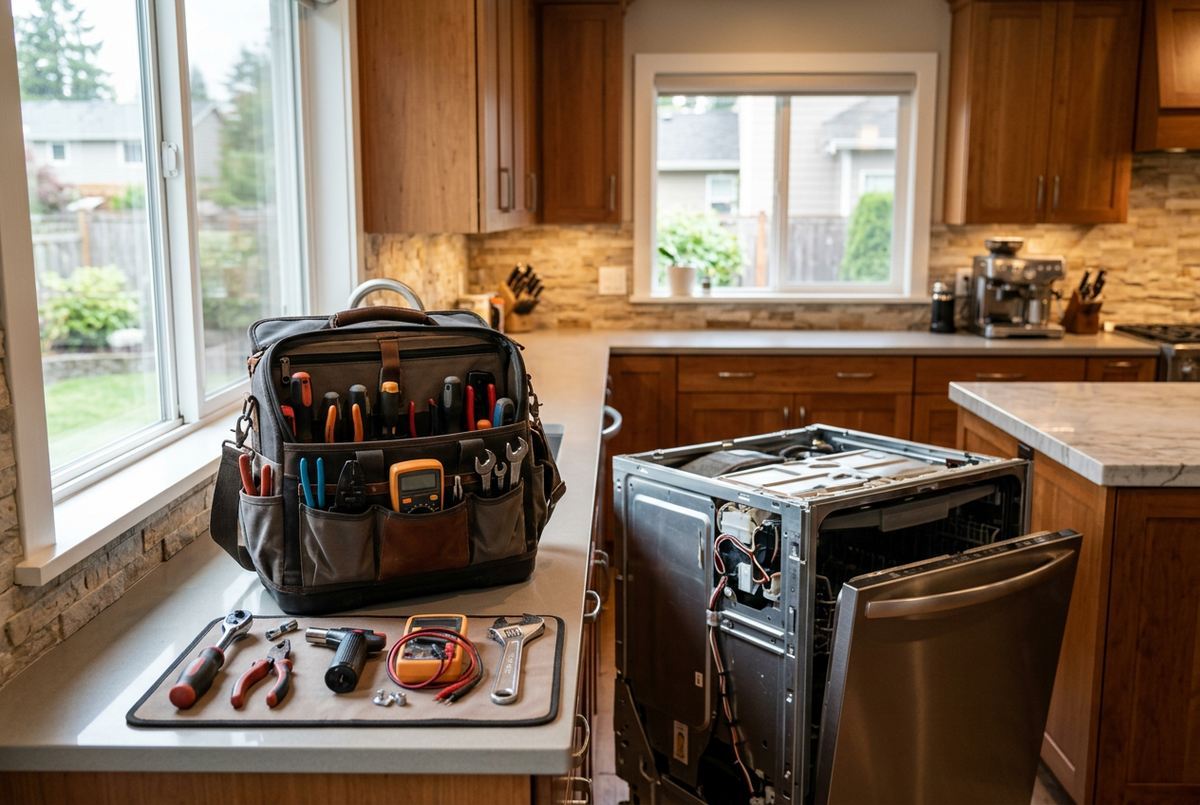
Now we're into things that need tools. The inlet valve is an electric valve that opens for a few seconds each cycle, and scale seizes it. The thermostat or sensor that says "the cubes are frozen, dump them" drifts out of range and never gives the order. The ejector motor or the mold heater fails. On door-dispenser models, the auger motor burns out. From the kitchen these all look the same: no ice. Sorting them out takes meter readings and a forced harvest, which is why guessing at parts online usually costs more than a visit.
Safe checks before you call us
Confirm the ice maker arm or switch is on, since someone may have flipped it off. The toggle is inside the freezer. Check that the bin is seated all the way, because many models won't cycle if it isn't. Follow the water line from the wall to the fridge and look for a kink or a closed valve handle. Replace the filter if it's been a year. If the fridge is tight to the wall, pull it out an inch or two. Stop there. Don't pry frozen parts loose, don't pour hot water in, and leave the back panel alone. Ring us with what you found.
Ice Maker Stopped Making Ice — fast answers
How long should I wait after resetting or refilling?
Give it a full 24 hours. Most ice makers run a cycle every hour or two, and the first batch after a water interruption is often small or cloudy. If the bin is still empty the next day, call us.
Why are my cubes small and hollow?
That's slow water fill. Usually a mineral-clogged filter, a partly closed valve, or a failing inlet valve. Our hard water is hard on all three. Start with the filter, then let a technician meter the valve.
Is it worth repairing an older ice maker?
Often yes, if the fridge cools well otherwise. Water valves, sensors, and ice maker assemblies are standard parts on most major brands. We'll tell you plainly what we find before any work starts.
How it works
- Step 1
Tell us the symptom
Ring us or fill in the form, then describe the noise, the smell, or the puddle. Brand and rough age help too. Those small details narrow down the part before anyone drives to your door.
- Step 2
We set a window
You get a visit window that fits your day, not ours, and we text when the van is close. Older shotgun houses have tight halls. Tell us where the machine sits.
- Step 3
Diagnose and repair
Our tech tests the machine, shows you what failed, and explains the fix in plain words. Common parts ride in the van. If something has to be ordered, we schedule the return trip before we leave.
- A real person answers
- Open 7 days
- Written quote before work starts
Why homeowners call us
- Hard water is our daily workLimestone water scales heating elements and clogs dishwasher jets, and it crusts up valves until they stick. We see it every week here. So we look past the error code to the mineral buildup behind it, then tell you how to slow the next round down.
- River-valley damp changes thingsHumidity in this valley rusts dryer housings and sours washer gaskets, and it stalls condensate drains. Basement laundry rooms have it worst. We check venting and drainage on every laundry call, because a dry machine stays fixed longer.
- Independent, all major brandsWe work on refrigerators, ranges, ovens, dishwashers, washers, and dryers from every major maker. No brand pays us, and no brand tells us what to say. When we talk about repairing versus replacing, that advice is ours alone.
- Old houses, careful handsShotgun homes and pre-war kitchens come with narrow doorways, soft floors, and odd wiring. We pad thresholds and protect trim, and heavy units move slowly. When we leave, the only change in your house should be a working appliance.
- All major brands, gas & electricIndependent service on Whirlpool, LG, Samsung, GE, Maytag, Bosch, KitchenAid and the rest.
- Straight answersIf it isn't worth repairing, we'll say so, often right on the phone.
About this guide
Past the safe checks, it's a job for tools and a meter
Mention which checks you ran when you book; it speeds up the visit.
- A real person answers
- Open 7 days
- Written quotes
- All major brands
- Gas & electric
Rather not call? Get a free quote →