Homeowners' pick for appliance repair across the Ohio Valley
Fixable Freezer Faults, and the Ones That End a Freezer
We repair residential freezers across Louisville and thirty counties in eight states, so if yours is warming up, call and describe what it's doing. Maybe the ice cream went soft, or frost is climbing the walls like a cave. You're standing in the garage with a bag of thawing chicken, wondering if this thing is worth fixing. Here's how we think it through.
Call (800) 967-1507- You reach a person, not a menu
- Open every day
- The quote comes first, in writing
Taking calls until 5:00 PM ET
By our service team · vetted by the techs who do this daily
Age matters, but not the way people think
A freezer that's eight years old and quit cooling is usually worth a look. One that's twenty-five and has been running loud for a year is a different conversation. What we watch for isn't the birthday on the tag, it's whether the sealed system is still healthy. Older chest freezers were built simple, and simple things stay fixable. Newer uprights carry control boards and adaptive defrost, which adds parts that can fail but also parts that swap out cleanly. Down here in the river valley, humidity ages door gaskets faster than anything else does. That's a cheap fix, not a death sentence.
Which faults we fix and which ones we don't love
Thermostats, door gaskets, defrost heaters and timers, evaporator fan motors, start relays, drain lines packed with ice. All normal repairs, and we do them constantly. A start relay failure looks dramatic. The freezer clicks, hums, goes quiet, warms up. It's a small part. The fault we get careful about is a leak in the sealed refrigerant system, or a compressor that's electrically dead. Those are big jobs, and on a mid-sized freezer the math often tilts toward replacement. Frost buildup is almost always a defrost or gasket issue, and warm-but-running usually points to airflow or the sealed side. We tell you which one it is.
Can we still get the part
This is the quiet dealbreaker. A freezer can be perfectly repairable on paper and still be finished, because nobody makes the control board anymore. Manufacturers stop supporting older models, and generic substitutes don't exist for every board. Mechanical parts age better. Gaskets, fans, thermostats and relays stay available for a long stretch. Proprietary electronics don't. When we identify a fault, we check availability before we talk about next steps. If the part is gone, we say so plainly instead of chasing a special order that never ships. No reason to leave you waiting on a box that isn't coming.
What actually happens when we come out
We start with the boring stuff, because the boring stuff is often the answer. Is the outlet live? Has a garage freezer been sitting in a cold unheated space where the thermostat stops calling for cooling? Are the coils choked with dust and lint? Does the door seal hold a dollar bill snug, or does it slide right out? Louisville hard water and basement damp leave mineral crust and mold on gaskets that break the seal. From there we check the defrost cycle, the fan, and how the compressor behaves on startup. Then we tell you the fault, the part, and whether we'd fix it if it were ours.
Times we'll tell you to replace it
A small chest freezer with a failed compressor is usually done. So is any unit with a refrigerant leak in the walls, since the tubing is foamed in and unreachable. Rust through the interior liner ends it. So does a cabinet that's been flooded, which happens in Ohio Valley basements more than folks expect. And if a freezer has already had two unrelated failures in a short span, that's the machine telling you something. We'd rather lose the job than sell you a repair we'd regret. Call us and describe the symptom. Sometimes we can narrow it down before anyone drives out.
When it is time to book
Related guides
Fixable Freezer Faults, and the Ones That End a Freezer — fast answers
Is a chest freezer easier to repair than an upright?
Often yes. Chest models have fewer controls and usually manual defrost, so there's less to fail. Uprights add fans, defrost heaters and sometimes boards. Both are repairable when the sealed system is sound and parts exist.
My freezer runs constantly but food is soft. What's wrong?
Usually airflow or sealing. Check the door gasket and make sure nothing blocks the lid. Heavy frost on the walls points to a defrost fault. Constant running with poor cooling can also mean a sealed-system issue.
Should I unplug it while waiting for a visit?
Leave it plugged in unless you smell burning or see scorching. Keep the door shut to hold cold. Move food to a cooler or a neighbor's freezer if it's already softening. Tell us what you observed.
How it works
- Step 1
Tell us the symptom
Ring us or fill in the form, then describe the noise, the smell, or the puddle. Brand and rough age help too. Those small details narrow down the part before anyone drives to your door.
- Step 2
We set a window
You get a visit window that fits your day, not ours, and we text when the van is close. Older shotgun houses have tight halls. Tell us where the machine sits.
- Step 3
Diagnose and repair
Our tech tests the machine, shows you what failed, and explains the fix in plain words. Common parts ride in the van. If something has to be ordered, we schedule the return trip before we leave.
- A real person answers
- Open 7 days
- Written quote before work starts
Why homeowners call us
- Hard water is our daily workLimestone water scales heating elements and clogs dishwasher jets, and it crusts up valves until they stick. We see it every week here. So we look past the error code to the mineral buildup behind it, then tell you how to slow the next round down.
- River-valley damp changes thingsHumidity in this valley rusts dryer housings and sours washer gaskets, and it stalls condensate drains. Basement laundry rooms have it worst. We check venting and drainage on every laundry call, because a dry machine stays fixed longer.
- Independent, all major brandsWe work on refrigerators, ranges, ovens, dishwashers, washers, and dryers from every major maker. No brand pays us, and no brand tells us what to say. When we talk about repairing versus replacing, that advice is ours alone.
- Old houses, careful handsShotgun homes and pre-war kitchens come with narrow doorways, soft floors, and odd wiring. We pad thresholds and protect trim, and heavy units move slowly. When we leave, the only change in your house should be a working appliance.
- All major brands, gas & electricIndependent service on Whirlpool, LG, Samsung, GE, Maytag, Bosch, KitchenAid and the rest.
- Straight answersIf it isn't worth repairing, we'll say so, often right on the phone.
About this guide
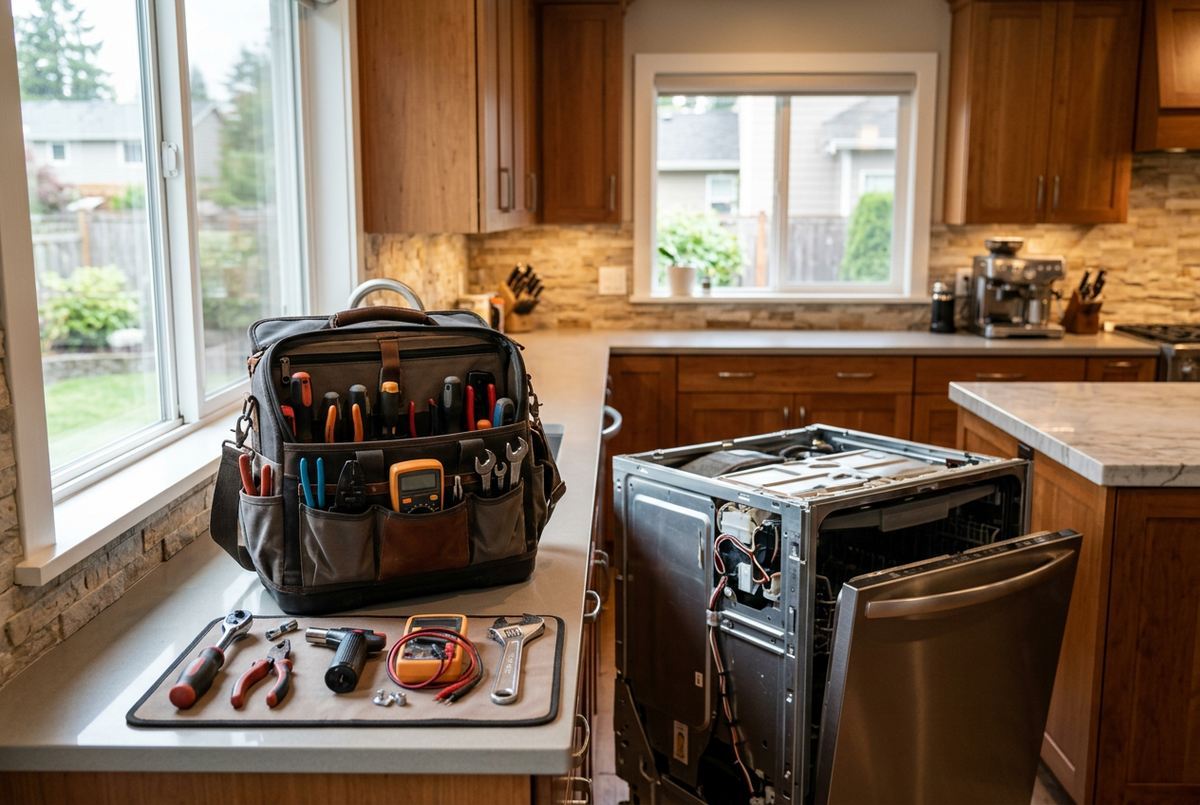
Past the safe checks, it's a job for tools and a meter
Report what you saw during the checks and we handle the rest. A minute to book.
- A real person answers
- Open 7 days
- Written quotes
- All major brands
- Gas & electric
Rather not call? Get a free quote →